A key that doesn't fit any lock in the house. A bus stop where nobody ever gets off. A voicemail from a number that was disconnected years ago. Prompts like these are generous — they hand you an image with a charge already in it. What they don't hand you is a story.
A story needs someone who wants something badly enough to act, something that makes acting difficult, and a last line that leaves the situation different from the first. Voice, style, the perfect opening sentence: all of that comes after those three pieces are in place. Here is how to get from one line of prompt to a draft you can actually work with.
The Prompt Is a Door, Not a House
The common beginner move is to spend the first page describing the object. The key is brass, worn at the teeth, cold from the coat pocket. Fine sentences, but nothing is happening yet — a prompt gives you a situation, and situations are static until a person walks into them.
So ask a smaller, sharper question: who is holding this thing, and what were they doing thirty seconds before they found it?
A woman is unpacking her late mother's coat and finds a key she has never seen.
Already there are three or four stories hiding in that line. She could suspect the mother had a second life. She could recognise the key from a house she broke into at nineteen. She could simply need the coat gone by Saturday and now be unable to throw it away. Same prompt, different books. None of them wrong. Pick the one you would stay up late reading.
Build a Character Who Wants Something
A short story cannot carry a vague protagonist. It needs a person with a want you could photograph. Not "she wants to be happy" — that is a mood, not a motor. Something like: she wants her sister's name off the lease by Friday. He wants the neighbour to admit the dog was his. She wants to leave the funeral before the eulogy.
Make the want concrete and close
The want should be small enough to be settled or refused inside a few pages. If it can't be answered by the end of the story, you have the seed of a novel and a frustrating short story. Give your character a deadline, a reason it matters this week, and one practical obstacle they can touch: a form to sign, a phone call to make, a box to carry downstairs.
Give them a private fear
Under the want, put a fear that makes the want expensive. Your character wants to confront her brother, and she is afraid of being the one who ruins Christmas — as she has been told she does. That fear decides how she argues, what she swallows, and where the story turns.
Two or three details of physical life will do the rest of the work. What's in the coat pocket besides the key? How does she hold a cigarette, or a phone, or a teacup? Skip the full biography. Readers build a person out of small evidence.
Put Something in the Way
Conflict is not shouting. It is friction between a want and an obstacle, and the friction has to be personal. A locked door is a delay; a locked door belonging to someone who once did you a favour is a story. When you plan the obstacle, choose the version that costs your character the most to face.
Most obstacles fall into four groups:
- Another person with a legitimate want of their own. The strongest conflicts have no villain — just two people who can't both get what they need.
- The character's own habit. She always apologises first. He never answers a direct question. The pattern must break or the story will not move.
- Circumstance. Money, distance, a shift that starts at six, a bus that stops running. Ordinary, unglamorous, effective.
- A truth being kept back. Not a secret for shock value, but something the character has decided not to say, and can no longer avoid.
Pick one primary obstacle and let it press on every scene. Three half-obstacles feel like noise.
Sketch the Shape Before You Write Sentences
Before drafting, write the whole story as four sentences. One per beat, no polish.
- The starting moment. A ordinary day is interrupted by the prompt image. She finds the key while bagging the coat for donation.
- The choice. The character decides to do something about it — a decision, not a feeling. She drives to the address on the keyring tag.
- The complication. The choice goes wrong, the cost rises, or the truth gets said. The house belongs to a man who knows her mother's name.
- The last move. A final action or recognition that shows the change. She keeps the key, or posts it back, or tells her sister. Keep it specific and physical.
Change is the engine. If the character ends the story with the same beliefs, relationships and plans as at the start, the reader will feel the effort was wasted. Resolution is optional; movement is not.
Draft Fast, Revise Slow
Write the first draft badly, on purpose
Set a target of 1,200 to 2,000 words and finish it in one or two sittings. Do not stop to fix the opening line. Write the bad version of every scene you're unsure of, with a note in brackets if you must, and keep going. A clumsy finished draft teaches you what the story is about; a beautiful unfinished one teaches you nothing.
Keep your four beats near the keyboard. When you get stuck, ask which beat you're in and write toward the next one.
Then cut with a knife
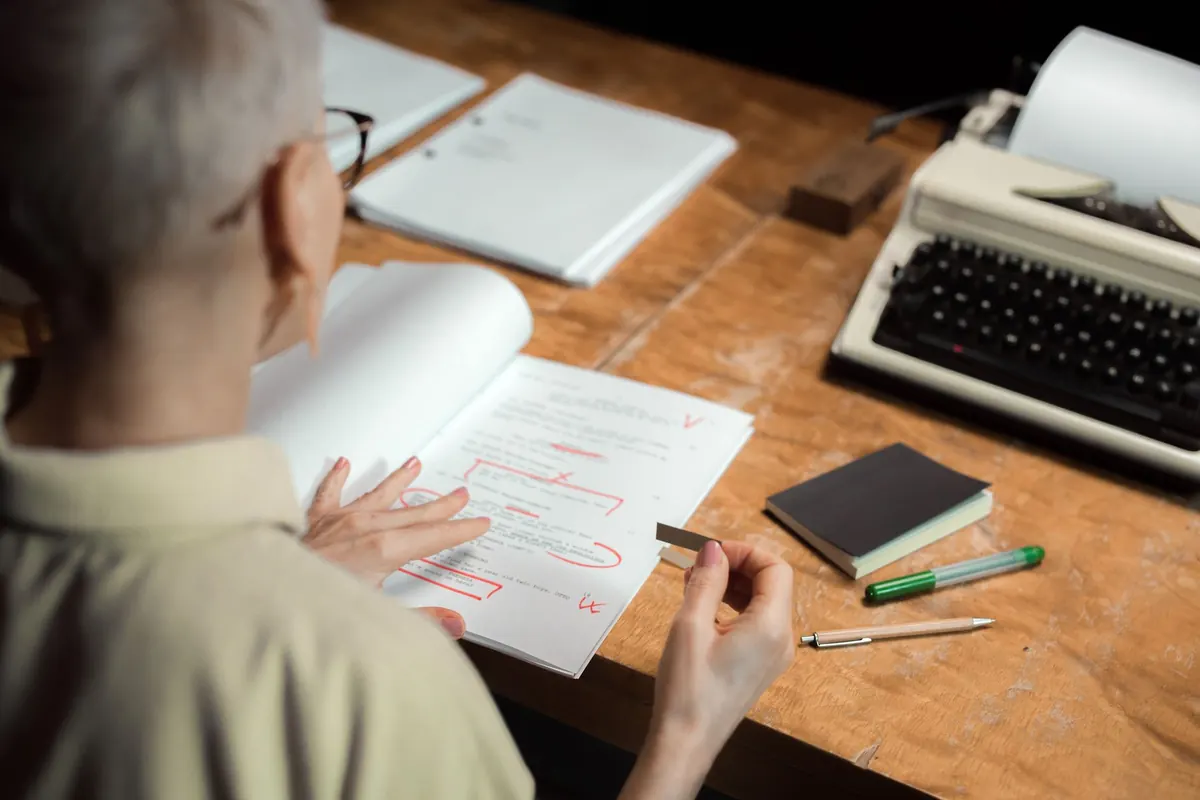
Leave the draft alone for a day if you can. Then read it aloud, slowly, and mark three things on a printed copy or in the margin:
- The real first line. It is almost never the sentence you wrote first. It is usually the moment something becomes unstable. Cut everything above it.
- Explanations. Anywhere you tell the reader what a character feels or why a scene matters, delete it and check whether the scene still works. If it does, it never needed the explanation.
- Scenes that change nothing. If a scene ends with the same situation it began with, cut it or merge it into the next one.
Watch for the four traps that sink most first drafts: an ending that explains the theme out loud, a twist that ignores what the character would plausibly do, a title chosen before the story existed, and a final paragraph that repeats the previous one in softer words. Stop when the story has landed. Trust the reader to close the distance.
Your First Draft This Week
Take the next prompt you come across and give it twenty minutes of thought before you write a word. Answer three questions on paper: who is here, what do they want by Friday, and what won't they admit. Then write your four-beat sketch in four sentences and draft it in one sitting without looking back.
You will end up with a rough story of 1,500 words and a clear sense of where it sags. That is the correct result. Revision is where the writing happens; the first draft is only the raw material you need to begin.
Photo: David Bares / Pexels