Most personal essays fail quietly. There is no dramatic collapse, no moment where the reader throws down the page—just a person who reaches the third paragraph, feels nothing in particular, and clicks away. The material was real. The sentences were competent. Something else went wrong.
What goes wrong usually falls into one of five categories, and every one of them is fixable in revision. These are the problems that show up again and again in workshop drafts, along with the specific moves that repair them. None of it requires a dramatic life. It requires the willingness to read your own sentences as though a stranger wrote them.
Mistake One: Reflection That Says Nothing
Drafts tend to end like this: That winter taught me a great deal about who I really am. The sentence is probably true. It is also portable—you could paste it onto any essay about any winter and it would fit just as well, which means it is telling the reader nothing.
Reflection in an essay is not a verdict you deliver at the end. It is evidence of change, and change is only visible in behavior. Put the two side by side. Here is the vague version: I learned to be kinder to myself. Here is the version a reader can actually see: By March I had stopped setting two alarms, and I ate breakfast standing at the counter instead of in the car. The second one hands the reader something to hold.
The practical fix is a subtraction test. Cross out every sentence containing the words learned, realized, or grew, then read what is left. If the essay still conveys the shift, the deleted lines were scaffolding holding up a wall that now stands on its own. If the essay collapses without them, you have found the paragraphs that need scenes in them.
One more question worth asking of any reflective paragraph: what did I do differently on the last page than on the first? If you cannot answer in a specific action, the reflection is still a summary of a feeling rather than a record of one.
Mistake Two: Nothing at Stake
A situation is not yet an essay. Something has to be wanted, and something has to stand in the way. Readers keep reading because they want to know whether the narrator gets it—and because they suspect it might cost something either way.
Many drafts open with a place and a season and a mood, and forty lines pass before anything is at risk. The fix is to establish the want early, inside the first page, even if it is small. A summer job in a bakery becomes an essay the moment the narrator admits: I wanted to be trusted with the ovens. Small stakes are not weak stakes. A wedding toast, a haircut, a phone call you keep not making—all of these can carry an essay if the desire is specific and the reader understands what failure would mean.
Stakes and drama are not the same thing. A quiet essay about learning to drive again after an accident can hold a reader for two thousand words. An essay about a genuinely harrowing year can lose them in three paragraphs if nothing is at risk on the page. The question is never how bad was it but what did this person stand to lose, and did I make the reader feel the possibility of that loss.
Two quick checks
- Can you name what the narrator wants in one sentence, without using the word understand?
- Can you name what would be lost if they didn't get it?
If either answer is fuzzy, the draft has mood but no engine.
Mistake Three: Telling It in the Order It Happened
First drafts follow the calendar. Essays follow meaning. If a paragraph exists only because the events in it happened second, it is a candidate for cutting, moving, or compressing into a clause.
The most reliable repair is a reverse outline. It takes about fifteen minutes and it is unglamorous, which is why it works.
- Number every paragraph, then write one sentence in the margin summarizing what each one does, not what it says.
- Label each paragraph: scene, thought, backstory, or summary. Dramatic essays rarely survive a run of four summaries in a row.
- Circle the paragraph where the trouble actually begins. Most drafts start two or three paragraphs too early. Move that paragraph to the front and see what happens.
- Look for ideas that repeat. The same insight usually appears three times in a draft; keep the sharpest instance and cut the rest.
- Check the middle. Anything you skimmed while writing it, the reader will skim while reading it.
Reordering is not cheating. A reader doesn't care what happened in what sequence—they care about being led somewhere. Begin near the trouble and let the background arrive when the reader needs it.
Mistake Four: Explaining the Point
You write a scene: a father repacks the car at midnight while everyone pretends to sleep. It's good. It's doing its work. Then you add, It was then I understood that grief never really leaves us. The scene already said that. The sentence is a neon arrow pointing at a sunset.
Over-explanation takes a few familiar shapes: the moral in the final line, the adjective that interprets the image for the reader, the hedge that softens every claim. I think, somewhat, a little bit—these are the sounds of an essayist apologizing for taking up space.
If you have to tell the reader how to feel about a moment, the moment is not finished yet.
Try this: delete the sentence that names the theme and read the paragraph aloud. If the meaning survives, leave it deleted. If it doesn't, don't add explanation back—add an image or an action instead. Let the last concrete detail in a paragraph do the interpreting. A reader who figures something out will believe it far longer than a reader who was told.
Mistake Five: Endings That Tie a Bow
Workshop habit dies hard: end with a tidy resolution, a wider lesson, a return to the opening image, a note of hard-won peace. Sometimes it works. Most of the time it flattens the essay, because experience rarely resolves—it rearranges.
A few endings worth trying instead. End on the last concrete thing that happened rather than the meaning of it. End one paragraph earlier than feels comfortable. End on a small action in the present tense of the story. Or end with the one thing you still don't know, stated plainly and without apology.
What to avoid is the announcement: And I knew then that everything would be different. Readers can feel a bow being tied. They will not trust it, and they will not thank you for it.
A Twenty-Minute Revision Pass
You don't need a complete rewrite. One focused pass, done honestly, catches most of these problems.
- Read it out loud. Mark every place your voice flattens. Those are your dead paragraphs.
- Circle every abstract noun. Love, loss, identity, growth. Each one needs a body: an object, a gesture, a line of dialogue.
- Underline where the want first appears. If it's on page two, move it up.
- Cut your final paragraph and read the essay again. Half the time, the draft is stronger and you'll know it immediately.
- Find the sentence you're proudest of and check whether it's earning its place or just showing off.
- Hand it to one reader and ask a single question: where did you get bored?
A good personal essay isn't the one with the most eventful life behind it. It's the one where the writer kept asking what a stranger can see. Answer that, five or six times, and the draft stops failing quietly and starts doing the thing essays are supposed to do.
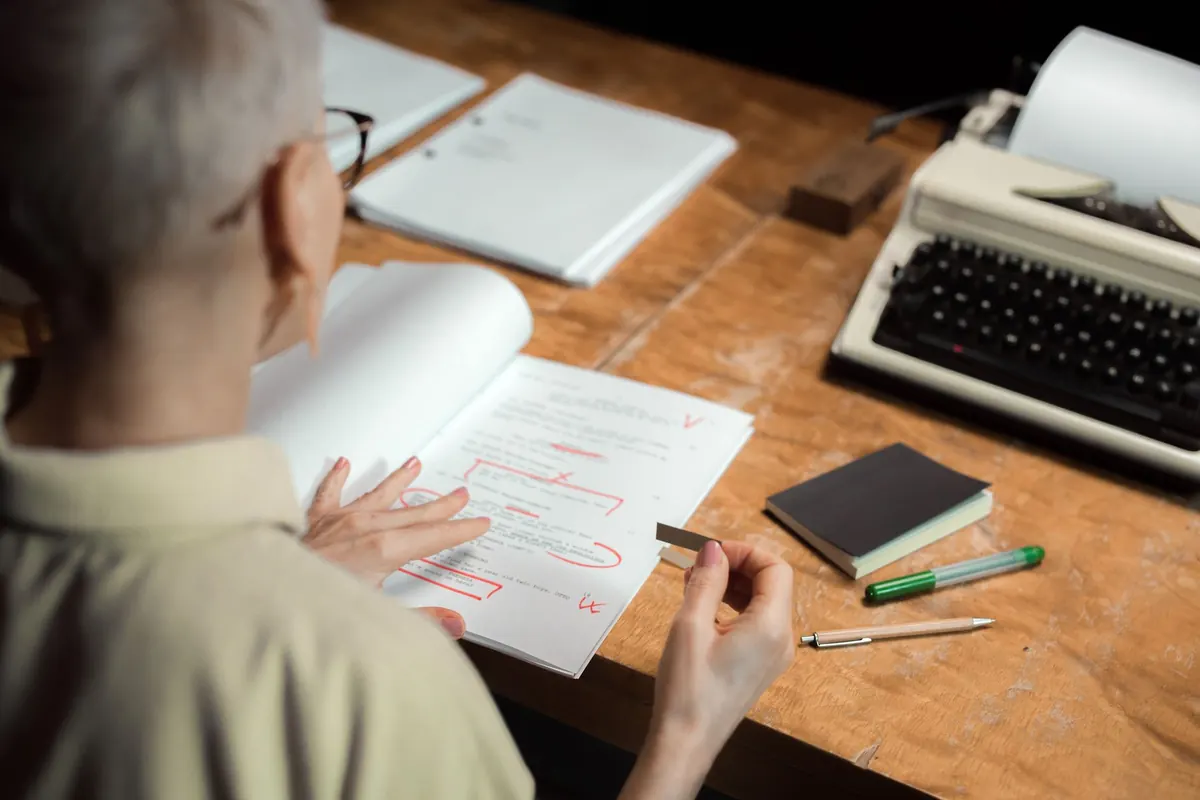
Photo: Ron Lach / Pexels